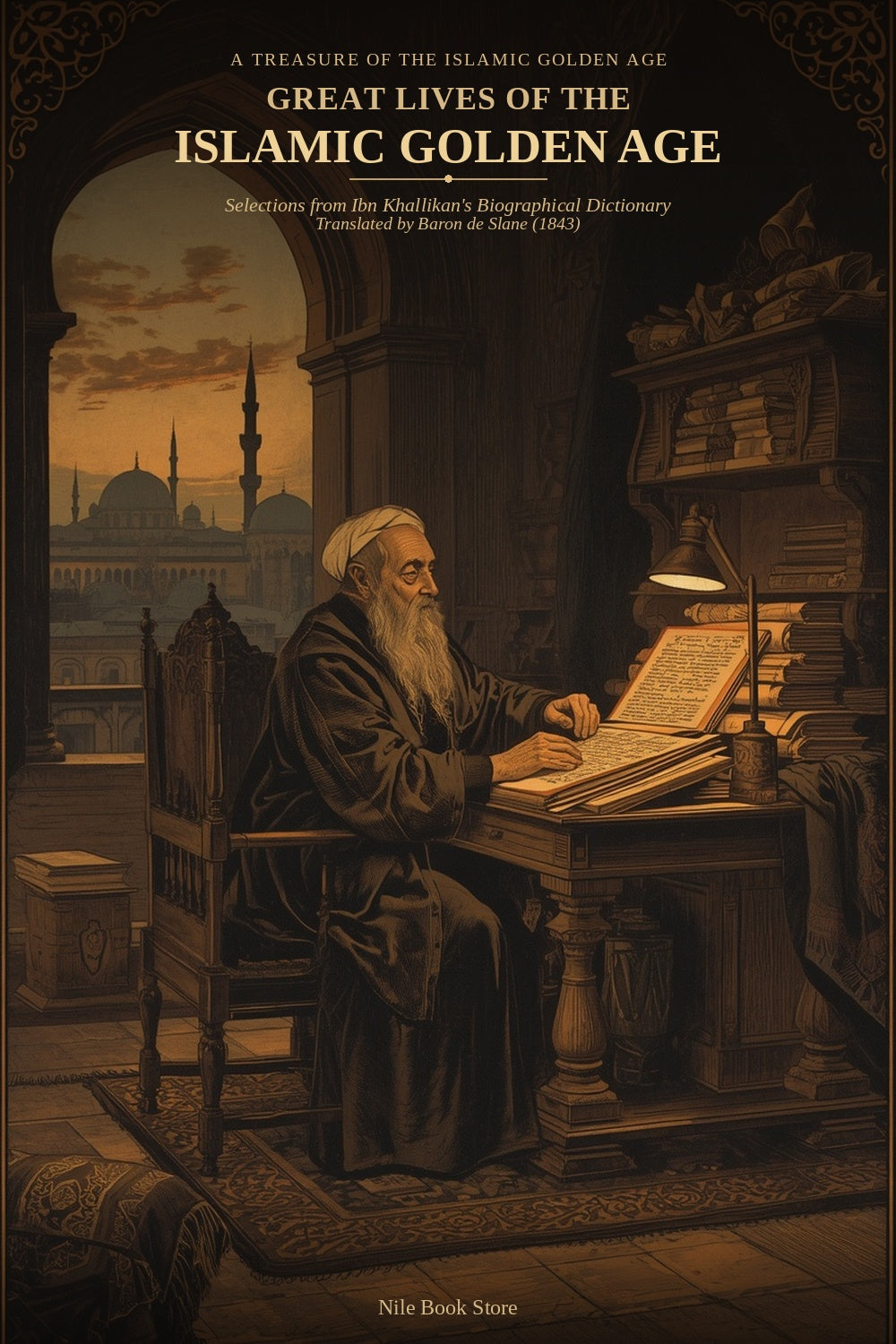
Ibn Khallikan
Great Lives of the Islamic Golden Age: Selections from Ibn Khallikan's Biographical Dictionary
Great Lives of the Islamic Golden Age: Selections from Ibn Khallikan's Biographical Dictionary
Download instructions are supplied after checkout. Read on a compatible EPUB or comic-reading app.
Couldn't load pickup availability
📖 Instant digital download — EPUB format
Description
In the 13th century, a Damascus judge named Ibn Khallikan set out to do something no one in the Islamic world had done before: gather the lives of its most remarkable people into a single alphabetical dictionary. The result, the Wafayat al-A'yan ("Deaths of Eminent Men"), became the model that every later Arabic biographical dictionary would follow — not a dry list of dates, but a collection of anecdotes, verses, deathbed scenes, and eyewitness testimony that brought its subjects back to life on the page.
This edition gathers four of its most vivid portraits from Baron de Slane's classic 1843 translation: the blind poet-philosopher Abu'l-Ala al-Ma'arri, who renounced meat for forty-five years out of compassion for animals; Abu Tayib al-Mutanabbi, still regarded by many as the greatest poet the Arabic language has produced; Imad ad-Din Zengi, the atabeg whose capture of Edessa in 1144 lit the fuse of the Muslim counter-crusade that Nur ad-Din and Saladin would carry to Jerusalem; and Zubaida, wife of Harun ar-Rashid, whose fortune built wells and way-stations along the pilgrim road to Mecca that bore her name for centuries. Four very different lives, told in the voice of a 13th-century scholar who clearly loved his subjects.
Author & Genre
Ibn Khallikan (1211–1282) was a Kurdish-born jurist who served as chief qadi of Damascus under the Mamluks. Genre: Classical Arabic biography / history, in Baron Mac Guckin de Slane's 19th-century English translation.
"I am he whose learning is seen by the blind, and whose word causeth the deaf to hear." — the line of al-Mutanabbi that Abu'l-Ala al-Ma'arri, sightless from childhood, singled out as though the poet had looked into the future and seen him
Share