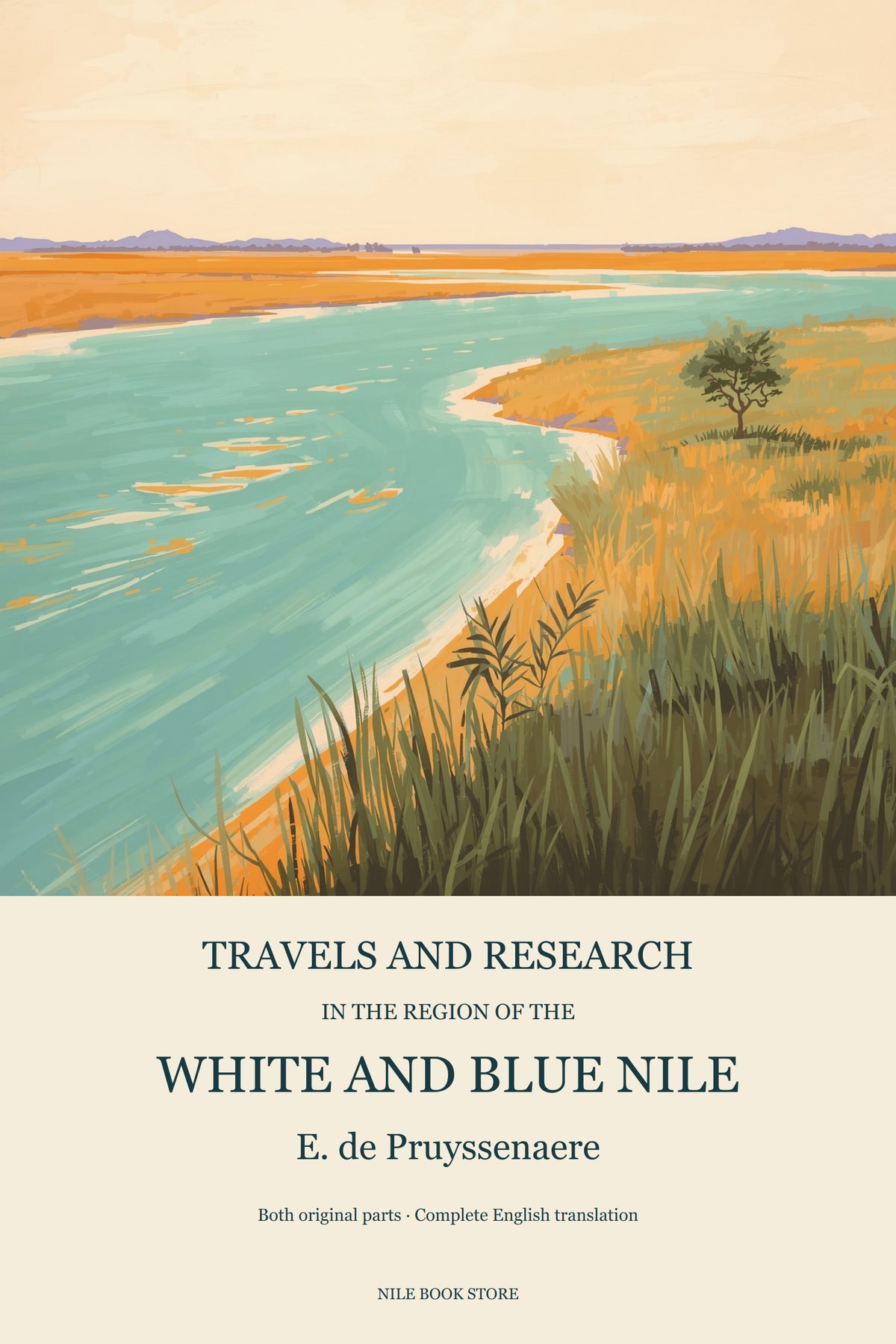
E. de Pruyssenaere
White and Blue Nile: Travels and Research — E. de Pruyssenaere (Complete English EPUB)
White and Blue Nile: Travels and Research — E. de Pruyssenaere (Complete English EPUB)
ستصلك تعليمات التنزيل بعد إتمام عملية الشراء. اقرأ الملف على تطبيقات القراءة المتوافقة.
تعذر تحميل معلومات توفر الاستلام
8 January. At Qetēna both banks are cleared of forest and cultivated. After a lengthy halt we again set sail, passing through a Sant forest to Wadi Sēlai, a village on the eastern bank that, like Qetēna, is under a mazūn with a few soldiers and was then the last place occupied by the government. Like the preceding village it consists of a cluster of straw toqūl covered with dung, with an attached rekūba, the whole surrounded by an enclosure or zerība. The opposite bank is heavily wooded. A shipbuilding yard, or mangara, has therefore been established a little farther south.[1] The soil of Wadi Sēlai appeared sandy and uncultivated to us, but during the dry season it is irrigated with the help of water-lifting devices (sadūf).
9 January. In the evening we again set sail with a very strong north wind. The temperature seemed very cold to us, although in the early morning the thermometer showed 17° Réaumur and in the afternoon rose to 23°. Hyenas, hippopotamuses and cranes appeared.
10 January. After a good night’s run we landed at sunrise on an island to take on wood. A few Arab cultivators inhabited it; they also owned camels and goats. We passed other low islands likewise cultivated by means of sadūf. The soil on both banks was sandy, but they were thickly clothed with various familiar species of mimosa, to which must be added the Qaqamūt, which supplies good, solid building timber. The undergrowth consists, as farther north, of Tūndub, Sērha and so forth. On this day ammunition was distributed to the men and a regular watch organized. We continued between wooded banks: the eastern one sandier, the western low and wet, covered with grass and low scrub. In the evening we cut wood on the eastern bank, whose inhabitants are Alawīn Arabs, though we saw only a few wretched toqūl built of branches. Despite there being no living soul in sight, the men did not dare go far from the bank, because the inhabitants hidden in the forest often watch for an opportunity to plunder and massacre. The Baqqāra on the opposite bank are scarcely more trustworthy. They cultivate little land, keep much cattle, as their name itself indicates, and live largely by robbery. Since they can do nothing to the barques passing along their shore, they compensate by shouting abuse at them, which sometimes draws gunshots upon them.
The landscape of the White River, with its flat banks wooded exclusively with mimosas, is certainly even more monotonous than that of Egypt and Nubia, which are already highly so; yet the sight of it is less wearisome than Nubia’s, and especially Egypt’s. One is glad at last to escape the stiff uniformity of the date palm, and gladly lets the eye rest on trees grouped much as in our own forests. The bleached trunks of old dead trees lie amid the lush vegetation of the living green ones. Man disappears from this immense horizon, which thereby acquires a rare character of sombre grandeur. One knows only that these thickets shelter wild animals and human inhabitants resembling them. The bank itself is deserted by people but animated by countless flocks of water and shore birds, among which the beautiful Egyptian goose stands out for its incredible numbers.
Both original parts, together in one complete English EPUB
Travel along the White and Blue Nile with E. de Pruyssenaere: river journeys, settlements and encounters, followed by detailed geographical, meteorological and astronomical observations. This translation presents the whole German edition published in Gotha by Justus Perthes in 1877, prepared and edited by K. Zöppritz from the traveller’s surviving records.
- Both physical parts, including the scientific third section and appendix.
- All substantive text, headings, footnotes, tables and appendices.
- Two original folding maps with translated legends, plus the original frontispiece.
- Reflowable English text, linked contents and preserved original page references.
The account is an edited historical publication, not an untouched diary. Historical names and prejudiced language are retained with context; uncertain readings and inconsistencies in the printed source are identified. The translation and source comparison were produced with AI assistance; no independent human scholarly certification is claimed.
Digital EPUB download. No physical book or shipping.
Source and image credits: Bayerische Staatsbibliothek München, 4 Geo.u. 124 u-50 and u-51; bsb11364714 and bsb11364715, digitized by Google. Exact sheet, scan and URN credits accompany the maps and frontispiece in the book. Cover: AI-generated Nile landscape created with Leonardo.Ai (Lucid Origin); evocative artwork, not documentary evidence. Historical map imagery is ancillary to the full new translation.
يشارك